The Making of DensDeck® ProFast™ Prime Roof Board

Truly innovative products aren’t created in a vacuum—they arise from creative problem solving. This is certainly true of Georgia-Pacific Building Products’ new, lighter gypsum cover board: DensDeck® ProFast™ Prime Roof Board.
In the Q&A that follows, we go behind the scenes with Chad Frank, Director of System Sales with 27 years at Georgia-Pacific; Vince Thomas, Principal Scientist with 17 years at the company; and Hamed Kayello, Product Manager for the Portfolio of DensDeck® Roof Boards with 7 years at Georgia-Pacific under his belt.
Find out how these innovators turned their customers’ field‑level needs into a resilient solution that answers the call for a faster roof installation, without compromising the reliability the DensDeck® Roof Board brand is known for.

Q: Were there any specific customer or industry pain points that drove the innovation?
A: Though you’ll find a proud team of engineers, scientists and salespeople that stand behind DensDeck® ProFast™ Prime Roof Board with enthusiasm, they didn’t create a new gypsum cover board just because they thought it would be cool.
Chad Frank explains, “We actually had a concerted effort to collect some insight a few years back. The feedback that we got from contractors was pretty consistent. You know, they wanted a product that was lighter but didn’t sacrifice performance. And anything we could do to make it either easier to install or positively affect their labor efficiency, right? Because we hear ‘labor’ all the time, shortage of labor, skilled labor, that kind of stuff.”
Hamed Kayello agrees, adding, “When we were thinking about this product and getting insights, ease of labor just kept coming up. Ease of labor and lighter weight were the two major things. So we said ‘OK, we might have a solution that we can go after.’ So that’s where [DensDeck®] ProFast™ Prime [Roof Board] came from.”
Q: How did you and your team take the field feedback and the problem you were trying to solve and go from there?

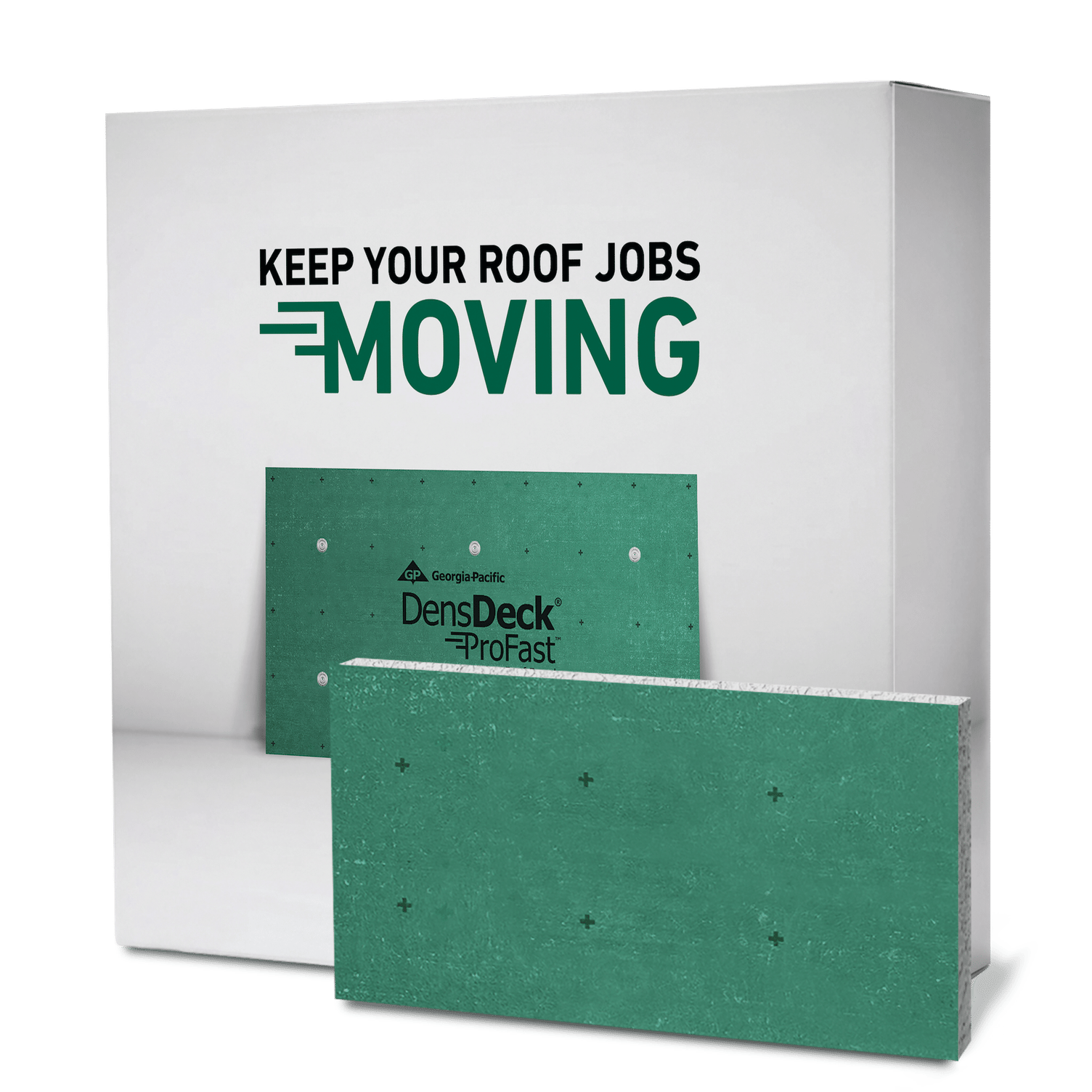
DensDeck® ProFast™ Prime Roof Board is approximately 20% lighter than 1/2″ DensDeck® Prime Roof Board, reducing the load on your roofing system and making it easier for your crew to handle and carry.
A: As the team set out to reduce weight without compromising board integrity, the initial reaction from bystanders was skepticism. But the team knew they could figure it out.
Vince Thomas says they started with how the board could perform under stress and worked backward. “We’re reducing fasteners, lightening the board, going to a 3/8″ board versus a 1/2″. So, we’re looking at the wind uplift test and asking, ‘How does it perform?’ And then, ‘What can we do to mitigate any issues … and still get those attributes?’ So, that’s kind of how we approached it.”
Q: For the testing that was conducted on it, how long of a process was this?
A: Hamed Kayello details the process: “So within this industry, especially when you come up with something completely new, things go a lot slower than you would anticipate because of certain requirements for testing and approvals. Depending on the third-party testing labs that have an opening for you … a lot of things are kind of skewed based on availability sometimes. But the idea was generated in 2022 and we kept moving.”
Q: As far as product differentiation on the market, what sets DensDeck® ProFast™ Prime Roof Board apart?
A: Chad Frank states, “Look, we’ve seen in the industry in the past and I think it was probably around 2010 when another roof board came out with a reduction in [roofing] fasteners. I think they reduced it down by two fasteners per board, but it required a special plate that was much more expensive if I recall. So, you know the industry’s been looking at how we can reduce the number of fasteners because it obviously directly correlates to labor cost reduction and material savings and it never really took off. [Meanwhile,] we were able to do it through the strength of the board, right? So, I think that’s really the differentiator.”
“It’s a beast of a board. It’s very strong. Lighter, less fasteners because it’s a very strong panel, much stronger than other products on the market and that’s what allows it to have those attributes.”
– Vince Thomas, Principal Scientist

1. The 25%–75% reduction in fasteners and plates is based on FM Approved assemblies using #15 fasteners and 3” metal flat-bottom plates.
Hamed Kayello adds, “If you look at what they call ‘the lightest weight cover board’ on the market. It became lighter by sacrificing performance and that’s not what we intended to do with this product. We intended to come up with a lighter-weight board compared to our 1/2″ DensDeck® Prime [Roof Board] and make it as strong or stronger. So, if you look at the board that we [ended] up making, [there are] certain aspects of the properties of that board that [are] way beyond anything you see in the market.”
Q: What type of roofing system and assembly design method is DensDeck® ProFast™ Prime Roof Board best suited for?
A: Hamed Kayello answers, “[DensDeck®] ProFast™ Prime [Roof Board] was designed for a specific system we call ‘partially adhered,’ and this is a system where your board is mechanically attached with fasteners and plates and your membrane is adhered to the top of the board.”
Chad Frank explains that while DensDeck® ProFast™ Prime Roof Board was designed for partially adhered assemblies, they hope the positive test results it’s had so far will allow it to be used in more ways, such as a roof substrate board or thermal barrier. It can already be used to replace 1/4″ DensDeck® Prime Roof Board as a thermal barrier, and the team is waiting on more testing for approval as a thermal barrier replacement for 1/2″ DensDeck® Prime Roof Board.
Q. How does DensDeck® ProFast™ Prime Roof Board directly improve the customer's daily life?
A: Chad Frank responds, “I think ultimately, the biggest one it’s going to affect is the end user, the contractor, right? And that’s who this was designed for.”
Hamed Kayello adds, “For system manufacturers, if you are inserting [DensDeck® ProFast™ Prime Roof Board] in certain systems, you might end up with a lower cost on the owner. Depending on how you compare things, if you’re really reducing the number of fasteners, you’re really reducing the number of hours that the crew is working on the roof … you are ultimately saving some money in the process, right?”
“It’s less strain on your crews, less drain on your budget and less stress on your timeline.” – Chad Frank, Director of System Sales
The team agrees that DensDeck® ProFast™ Prime Roof Board could open the door to replace heavier products on certain roofs that are restricted by how much load they can handle. For example, snow loads and rooftop equipment. They also believe it could give system manufacturers another option to consider when they want to be first to market with their unique system designs.
What's Next?
Regardless of what comes next, the DensDeck® Roof Board team takes the designation of “industry leader in cover boards” seriously. They feel a level of expectation from their system manufacturers and roofing contractors to continue to innovate, and they look forward to meeting that demand.
Visit densdeck.com/profast to get your sample of the new DensDeck® ProFast™ Prime Roof Board.
1. The 25%–75% reduction in fasteners and plates is based on FM Approved assemblies using #15 fasteners and 3” metal flat-bottom plates.